
Shocking, Bizarre, and Heartbreaking: Inside the CAS Report that Reveals Key Details about Kamila Valieva's Hearing
The 129-page report explains how the CAS panel found Kamila Valieva "to have committed an anti-doping rule violation" and why they imposed a four-year ban

In the more than 700 days I’ve covered Kamila Valieva’s doping violation, never have I read such shocking, bizarre, and heartbreaking details about the case.
CAS released a 129-page report last week that takes us into the heart of Valieva’s hearing: “The Grandfather Explanation,” said grandfather not existing, a mysterious strawberry dessert (!!!), SIXTY medications that Valieva was taking, and “an air of unreality.” Let’s dive in.1
Welcome back to “On Thin Ice: How to Save a Dying Sport,” a newsletter by me, @FS.SkatingStan! If you’re passionate about modernizing, reforming, and improving the wonderful sport and art of figure skating, you’re in the right place. At least once a month, you’ll receive an email from me focusing on an area in which skating can change for the better.
Thank you for subscribing. I’m so happy to see you a part of this community!
What was Kamila Valieva’s explanation for testing positive for Trimetazidine (TMZ) at the 2022 Russian Figure Skating Championships?
Ingestion: Referred to as “the Grandfather Explanation” in the report, this is the main explanation Valieva provided in interviews prior to the hearing, and during her testimony at the hearing. She claimed she could have ingested TMZ via food prepared by or shared with her grandfather, Mr. Solovyov.
Contamination: Valieva claimed that contamination of her medication or supplements could have led to the positive test.
Sabotage: Valieva suggested that “an intruder” could have planted or slipped a banned substance in her food or water.
🍓What is “the Grandfather Explanation” and what does a strawberry dessert have to do with this?
The main argument that Valieva put forward as to how she tested positive for TMZ is referred to as “the Grandfather Explanation” in the report. Here’s how it works:
Valieva’s grandfather took TMZ for a heart condition
Because her grandfather took her to the rink and spent time with her, he prepared food for her
The evening before Valieva left for Nationals with her mother, her grandfather made a strawberry dessert for her
The grandfather, in a written statement, believes that the dessert became contaminated with TMZ because he accidentally dropped a pill in the dessert or there was crushed pieces from his medication on the chopping board that he used to prepare the dessert
Valieva then ate the dessert in the days leading up to Nationals
“Yes we had lunch, Grandfather also often gave me something like apple pure or a berry sweet made from berries … condensed milk, bananas or some juice, and maybe … He also takes pills following the doctors’ recommendations and, probably, this pill got into a dessert, which he usually gives to me. Or, I saw a few times accidentally, that he crushed the pills with the knife and dissolves them in a glass, and took them. So I might have drunk from the same glass or there, at home, I might have eaten something from the same chopping board and so on.”
— Kamila Valieva, Interview with the Russian Anti-Doping Agency (RUSADA) on July 26, 2022
What was the defense Valieva and her legal team put forward?
In addition to the Grandfather Explanation, Valieva and her legal team pointed out:
Apart from the December 2021 sample, she has provided 17 samples that have never tested positive
She always checks to make sure that her medication and supplements do not contain prohibited substances
She takes a lockable suitcase with her to competitions and never leaves it unsupervised and unlocked
She’s taken educational anti-doping programs and has been repeatedly told by her coaches about precautions that she should take with her food and drink
She didn’t know that her grandfather was taking a banned substance
Valieva would not have risked 11 years of hard work as well as her participation in the Olympic Games “to use a medication with unproven efficacy on the athletic performance and numerous side effects, including dizziness”
How did the ISU and WADA Respond to Valieva’s Grandfather Explanation?
The International Skating Union (ISU) and the World Anti-Doping Agency (WADA) poked many, many holes in the Grandfather Explanation. Here are just a few of the ways they showed that the explanation lacks solid evidence.
“It is ‘inherently implausible’ that an athlete at this elite level would take a homemade strawberry dessert with her across Russia and eat it during a competition period.”
— World Anti-Doping Agency, Page 61 of the CAS Report
Mr. Solovyov, the grandfather, refused to testify before CAS on account of health issues
No medical records were produced to show that her grandfather had a heart condition between 2008 and an undated medical record
There’s no evidence of Mr. Solovyov, the grandfather, purchasing or using TMZ
The only evidence in relation to Mr. Solovyov’s use of TMZ are two medical records that are dated AFTER the February 8, 2022 notification to Valieva that she tested positive
There’s no evidence to prove that Valieva took the strawberry dessert with her to Nationals. In other words, none of Valieva’s teammates, or the train attendant who Valieva said she gave the dessert to, were called to testify and prove that the dessert existed
The ISU pointed out that Mr. Solovyov drove two hours to Valieva’s apartment to drive her to practice every day - despite having a weak heart. Where was practice? Only 200 meters (0.12 miles) away. That’s a 3-6 minute walk!
Valieva’s mother said that her grandfather drove her because of a disturbing incident where Valieva “was once followed by her male fans ‘to become acquainted.’” If we are to believe Valieva’s mother, that’s terrifying. But it still doesn’t explain why a teammate’s parent or someone from the rink couldn’t have driven Valieva to the Ice Palace if she lived so close.
Did CAS believe “the Grandfather Explanation”?
No. The CAS panel was highly skeptical of the Grandfather Explanation.2
There was no evidence relating to the grandfather using TMZ prior to the 2022 Russian Figure Skating Championships
There was no evidence of TMZ being prescribed to Valieva’s grandfather - no statement from his doctors, no receipt or credit card statements, and no witness statement from a pharmacy
Valieva’s grandfather said he “always” takes tablets by chewing them, and then in a later interview he stated he crushed them on a chopping board
No one aside from Valieva and her grandfather can testify to the existence of the strawberry dessert
CAS also noted that they had no opportunity to assess the witness or his evidence - because the grandfather never testified in front of them! He declined to testify due to health issues, but CAS says there’s no evidence that he even has health issues. That’s WILD. CAS ultimately based their decision on the grandfather’s pre-recorded video statement and his witness statement.
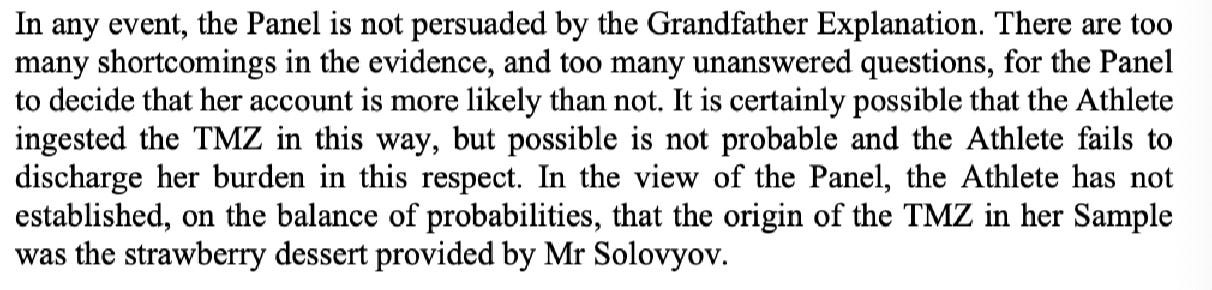
What I think is the most curious part of the Grandfather Explanation is that Valieva and her grandfather switched their stories. In a video statement from February 2022, Valieva’s grandfather talks about residue of TMZ possibly being on the surface of a glass, and he never mentioned a strawberry dessert. Drinking from the same glass of water has been, until now, the primary explanation circulated by Valieva’s team to the media and fans. Then in a May 2022 statement, the grandfather makes the first mention of the strawberry dessert. Just a month later in an interview with Valieva, she doesn’t mention the dessert. But by December 2022, she starts to mention the dessert as a way she could have tested positive for TMZ.

What was CAS’ final ruling?
CAS found that Valieva committed an anti-doping rule violation because of the presence of TMZ in her sample. Valieva will now face an ineligibility period of four years, starting December 25, 2021, the day that she submitted her sample that later came back positive.
Valieva’s competitive results after December 25, 2021, including the 2022 Russian Figure Skating Championships, 2022 European Figure Skating Championships, and 2022 Olympics, are disqualified. Valieva must forfeit any titles, awards, medals, profits, prizes, and appearance money as well.
What are the most shocking revelations from the report?
Valieva was taking 60 supplements and medications between 2020-2021. That means that at age 13, Valieva was taking a cocktail of drugs that would have had adverse side effects (nausea being one of them - and she was also on an anti-nausea medication). They were mostly supplements, and treated everything from a runny nose, to muscle pain, to preventing OSTEOPOROSIS, a condition that causes bones to become weak and brittle and is most commonly found in people older than 50.
The report states that Valieva’s grandfather doesn’t exist. Yes, you read that right. Despite this dramatic statement from RUSADA, Mr. Solovyov does exist, he’s just not Valieva’s blood grandfather. He’s the father of Valieva’s mother’s former partner.

WADA used Eteri’s own words against her. WADA cited a 2019 interview that Eteri gave in which she confirms that her team used meldonium for improved recovery. After meldonium was banned by WADA in 2016, Eteri said, “we had to look for something else.” TMZ and meldonium have similar properties. CAS rejected WADA’s line of reasoning, stating that Eteri could have been talking about any drug, and her interview does not prove that Valieva’s ingestion of TMZ was intentional.

What are the most interesting things we learn from the report?
There were other drugs detected in Valieva’s sample. While TMZ was detected in both Valieva’s A and B samples, other drugs, which are permitted by WADA, were detected as well: hypoxen (reduces oxygen consumption and improves lung capacity), L-carnitine (helps the body turn fat into energy and is used as a weight loss supplement), and Ecdysterone (a dietary supplement used to enhance strength and muscle recovery).
Travis Tygart, the chief executive of the United States Anti-Doping Agency, said that the benefits of such a combination [of drugs] “seem to be aimed at increasing endurance, reducing fatigue and promoting greater efficiency in using oxygen.”3
Eteri knew that Dr. Fillip Shvetskiy had been accused of violating anti-doping rules but did not consider this an issue. It is a HUGE risk to have a doctor on your team who has been sanctioned and whose athlete’s sample was found to contain a banned substance in 2016. But Eteri claimed this wasn’t an issue because Dr. Shvetskiy doesn’t manage the medical treatment for the skaters; he organizes consultations and helps provide first aid at competitions.
According to the ISU, Valieva had a “blind relationship” with her sports doctors, meaning that she does not appear to have asked whether the substances she was prescribed were legal or not.
The CAS Panel found Valieva to be “an honest, straightforward and credible witness and her protestations of innocence believable.” This supports the belief that many fans hold — that Valieva did not know she was being given TMZ.
Valieva is required to forfeit profits and prize money. How exactly will this work? Does this mean that Valieva must return the money she won from Europeans and the Olympics back to the organizations that awarded her? And who makes sure that Valieva actually returns the profits - the ISU? RUSADA? WADA?
What is the biggest takeaway from the report?
The adults in Kamila’s life failed her. As even Russian fans point out, to this day, there has been no comprehensive investigation of Valieva’s coaching and medical team and the role they may have played in all of this. Eteri completely distanced herself from the investigation into Valieva, claiming she has no oversight over the medication and supplements that her students take and stating that Valieva never complained of heart problems to her. Eteri didn’t even attend Valieva’s hearing or testify on her behalf - Daniil Gleikhengauz did. Meanwhile, Valieva’s grandfather is nowhere to be found and refused to testify in front of CAS, which hurt Valieva’s case.
Valieva was left to fend for herself. It makes you wonder if CAS’ decision truly means justice has been served.
The Medals 🥇🥈🥉
The controversy only continues with the redistribution of medals from the 2022 Olympic Team Event. The ISU recently released a statement that the U.S will win team gold, Japan will win the silver, and the Russian Olympic Committee (ROC) will win the bronze. Skaters, fans, and journalists reacted with fury - because by awarding ROC the bronze, the ISU didn’t follow their own rules.
According to the ISU’s rules, when a competitor is disqualified, competitors who initially placed lower than the disqualified candidate will move up according to their placements. If the ISU had moved the women skaters up a placement in the short and free programs, Canada would have won the bronze.
After countless unanswered emails from reporters to the ISU and International Olympic Committee, the ISU released a new statement that states that their own rules don’t apply to this decision because reallocating points “could negatively affect the relative team ranking, adversely impacting teams that had nothing to do with the incident in question.” My interpretation of this is that the ISU is saying that following their own rules would hurt ROC because they’d be bumped off the podium to fourth place. But there doesn’t seem to be any consideration for how this decision hurts Canada, who had a team with all clean athletes. Some fans on Reddit have rightfully pointed out that in different situations, reallocating points could affect other teams’ placements, and that may be what the ISU is referring to.
“Say teams A and B are tied at the end, and placed 2nd (A) and 4th (B) in the women's portion, and the 3rd place finisher is later disqualified. If you reallocate points, team B benefits, and team A loses out. So that's a reason why as a general rule, you might not want to reallocate points, because it might affect different non-offending parties unequally.”
Skate Canada and the Canadian Olympic Committee have announced they are exploring all options to appeal the ISU’s decision. An appeal could take years, and it makes you wonder when Team USA and Team Japan will finally have their medal ceremony. They may receive their medals at the 2024 World Championships in Montreal or at the 2024 Paris Olympics before a decision is rendered for Canada. Does that mean ROC would be at the medal ceremony to receive their bronze medals? Or will athletes have to wait until the appeal is decided to receive their medals?
What’s interesting about the medal controversy is that it calls into question the media and communications strategy of these skating organizations, and the political pressure this can exert. Say what you want about U.S. Figure Skating (USFS), but they were strategic and savvy when it came to keeping the American public informed about the medal controversy. USFS created a museum exhibit; launched a social media blitz of photos, videos, and a shared hashtag; had skaters like Vincent Zhou appear in print and TV news over the last year discussing this issue; and are now using the Olympics, NBC, and the Today Show’s social media to publicize that American athletes have finally received their medals. Canada’s situation is a bit different because a medal was never a guarantee and it depended on the outcome of the CAS hearing, but it’s odd that Skate Canada has been silent for over two years. It’s also strange how none of the Canadian skaters from the 2022 Team event have spoken out, especially those who are now retired. As Meagan Duhamel asked, “Why am I fighting for their medal? Why am I trying so hard to get Eric and Vanessa an Olympic medal?” Well said, Meagan.
👀 What I’m keeping an eye on: Junior Worlds entries are out, Canada is preparing to announce what will surely be a controversial Worlds entries list on February 14, and backlash from the ISU Awards is spreading on social media (let’s be real - have these awards done anything but ignite fan wars? Isn’t the purpose of the Awards to bring fans together and boost skating’s profile?)
🎉 What I’m celebrating: A sold out crowd and over 50,000 tickets sold at U.S. Nationals, thanks to Columbus sports culture and USFS working with the city’s tourism board! If only the performances lived up to the energy of the audience…
📖 What I’m reading: Gracie Gold’s memoir, “Outofshapeworthlessloser: A Memoir of Figure Skating, F*cking Up, and Figuring It Out.” One of the most poignant quotes:
“Russia has turned cheating into a high-level, intricate, almost artful endeavor. The Russians have shown themselves to be the runaway gold medalists of doping. Congratulations to them.”
If you’ve made it this far, thanks for joining this community! Feel free to reach out to me on Instagram with feedback on what you’d like to see me cover in the future.
Did a friend forward this to you? Subscribe for more skating news!
NOTE: This newsletter is not meant to be a comprehensive overview of CAS’ report, but an overview of the most important pieces of information. You can read the full report here.
In order for the CAS panel to decide what consequences Valieva should face, they needed to decide whether Valieva took TMZ intentionally. But it was difficult for the panel to decide intentionality without evidence as to how TMZ ended up in her system. That’s why they focused so much on the Grandfather Explanation.